
How long does ceramic coating last in Kentucky weather? Louisville owners usually ask this after their first humid summer or icy winter. The answer depends on the coating tier, the application quality, and how much heat and salt the paint takes on. Advanced Mobile Detailing has applied ceramic coatings across the Louisville area long enough to see clear, repeatable patterns. Those patterns set realistic expectations before booking ceramic coating services in Louisville, KY.
Key Takeaways
- Most consumer-grade coatings last 1 to 3 years in Kentucky; professional-grade tiers can reach 5 to 9 years with care.
- Louisville’s summer UV, humidity, and winter road salt pull real-world results toward the lower half of any manufacturer’s rating.
- Higher-tier coatings use denser, more cross-linked formulas that resist Kentucky’s freeze-thaw winters better than entry-level products.
- Road salt does not ruin a properly maintained coating outright, but rinsing lower panels after storms keeps protection intact longest.
- Fading water beading is usually the first sign a coating needs a maintenance detail or renewal.
- Kentucky weather alone does not void a ceramic coating warranty; neglect and skipped inspections do.
How Long Does Ceramic Coating Typically Last?
Most consumer-grade ceramic coatings last 1 to 3 years. Professional-grade coatings can last 5 to 9 years with proper care. Those figures come from lab testing, not Louisville driveways.
Kentucky’s humid summers, freeze-thaw winters, and road salt pull real-world results toward the low end of that range. A coating rated for 5 years might only reach 4 to 5 years locally with steady upkeep. A neglected coating can thin out much sooner.
Mileage and parking habits matter almost as much as the coating itself. Vehicles parked outside and driven daily face more UV, grit, and temperature swings than garage-kept cars. That extra exposure shortens the real lifespan, no matter what the warranty promises.
Why Louisville’s Summer Heat and UV Exposure Wear Down Ceramic Coatings
Louisville sees about 195 sunny days a year, with highs near 90 from June through August. That steady UV load is one of the fastest ways to break down a coating’s protective bonds. Advanced Mobile Detailing sees this wear pattern most often on vehicles parked outside all summer.
That wear shows up as fading gloss, weaker water beading, and eventually a rougher surface texture. Vehicles that stay coated through several Louisville summers still benefit from the protection, just not indefinitely.
Summer Heat and the UV Index
Ultraviolet exposure triggers photodegradation, a process where sunlight breaks chemical bonds in coatings and clear coats alike. A ceramic coating slows this breakdown by forming a cross-linked barrier over the paint. That barrier still weakens gradually under repeated summer sun.
UV resistance and UV blocking are not the same thing. A coating can look glossy while its resistance to heat and light quietly declines.
Does Vehicle Color Affect Ceramic Coating Wear in Louisville?
Dark-colored vehicles absorb more heat than light-colored ones. Surface temperatures can run 10 to 20 degrees hotter on a black car during peak summer afternoons. That extra heat speeds up the same expansion and contraction that ages a coating.
Black, navy, and dark gray vehicles often fade and wear faster than white or silver ones parked the same way.
Humidity and Rapid Temperature Swings
June, July, and August are Louisville’s most humid months. That moisture speeds up oxidation on any coating that has already started to thin. Add mornings near 60 and afternoons near 90, and the paint constantly expands and contracts.
That constant cycling stresses the coating’s bond to the clear coat. Vehicles left outside year-round tend to show wear earlier than garage-kept ones.
How Kentucky Winters and Road Salt Add Extra Wear
Winter brings a different set of stressors. Louisville averages 8.7 inches of snow a year, and crews apply salt and de-icers to keep roads clear. That salt loses effectiveness once temperatures drop near 15 degrees, according to the Kentucky Transportation Cabinet.
Road salt is corrosive and can sit on lower panels and wheel wells for days during a storm. A quality ceramic coating helps salt brine and grime slide off instead of bonding to the paint. That protection fades faster on lower panels that take the brunt of the spray.
Freeze-thaw cycles compound the problem. Temperatures can swing from below freezing overnight to well above it by afternoon. That repeated cycling stresses a coating already softened by summer heat, so rinsing after storms helps it hold up.
Does Ceramic Coating Help Prevent Rust From Kentucky Road Salt?
Ceramic coating does not stop rust outright. Rust forms when bare metal meets moisture and oxygen, not simply when clear coat is dirty. A coating helps by reducing how long salt brine sits against the paint.
Rocker panels, wheel wells, and lower door edges take the worst of it each winter. They face direct spray from salted roads for months at a time. Coating these areas, along with the rest of the vehicle, offers the most protection where rust risk is highest.
Existing chips and scratches stay vulnerable no matter how good the coating is. Older vehicles with surface rust need paint correction before applying a coating. Coating over active corrosion only seals in the problem instead of solving it.

Which Ceramic Coating Tier Lasts Longest in Kentucky Weather
Not every ceramic coating meets the same standard. The tier you apply directly affects how well it survives Kentucky’s climate swings. Advanced Mobile Detailing offers several tiers through its detailing packages and pricing, each rated for a different level of durability.
| Coating Tier | Manufacturer Rating | Realistic Kentucky Lifespan | Starting Price |
| Original (1-Year) | 1 year | 8 to 12 months | $499 |
| EXO V5 (2-Year) | 2 years | 18 to 22 months | $799 |
| Ceramic V3 (3-Year) | 3 years | 2.5 to 3 years | $999 |
| Crystal Serum Light (5-Year) | 5 years | 4 to 5 years | $1,200 |
| Crystal Serum Light + EXO (5-Year) | 5 years | 4 to 5 years | $1,600 |
| Ultra V3 (5-Year) | 5 years | 4 to 5 years | $1,299 |
| Crystal Serum Ultra (9-Year) | 9 years | 7 to 9 years | $2,000 |
These are general estimates, not guarantees. Results vary by storage, wash habits, and how much winter driving a vehicle sees each year. Higher tiers close the gap between the manufacturer rating and the realistic Kentucky lifespan.
Higher tiers use denser, more cross-linked formulas that resist heat and salt better than entry-level products. Drivers who park outside year-round generally get more long-term value from a 5 to 9-year tier. The higher upfront cost spreads across a much longer protection window.
Does Kentucky Weather Void a Ceramic Coating Warranty?
Kentucky weather itself does not void a ceramic coating warranty. Most manufacturer warranties cover normal exposure to sun, rain, and typical winter driving. That kind of exposure counts as expected use, not abuse.
Neglect is what actually voids coverage. Skipping washes for months, using an automatic brush-tunnel wash, or leaving road salt on for weeks can void it. Those habits accelerate wear beyond what the coverage is designed to handle.
Longer warranties, like the 5 to 9-year tiers, usually require an annual inspection to stay active. Keeping a simple record of washes and inspections makes a future claim easier to file.
Signs Your Ceramic Coating Is Starting to Wear Down
A few clear signs show when a ceramic coating is wearing thin. Catching them early makes maintenance cheaper than a full reapplication.
Most of these signs develop gradually rather than overnight. Spotting them during a routine wash makes it easier to catch wear before it spreads across the whole vehicle.
Water Beading Fades
A healthy coating sheds water in tight beads that roll off fast. When beading flattens out, or water starts sheeting across the hood, the hydrophobic layer is thinning.
Dullness on High-Contact Panels
Dullness often shows up first on the hood, roof, and trunk lid. A coated finish should hold deep gloss even after weeks without a wash. Fading between details is a sign the coating needs attention.
Increased Contamination
Road grime, bug residue, and brake dust that used to wipe off easily can start clinging to the paint. That means the protective surface has worn thin enough to let contaminants bond to the clear coat.
Light Swirl Marks
New swirl marks after routine washing are a fourth warning sign. A strong coating adds scratch resistance against fine marring. Fresh swirls under sunlight often mean that buffer has worn away.
How to Extend Ceramic Coating Life Through Every Kentucky Season
Seasonal habits matter more than any single product. A routine built around Kentucky’s real weather works better than a generic care sheet. It is what helps a coating reach its full rated lifespan.
Spring and Summer Care
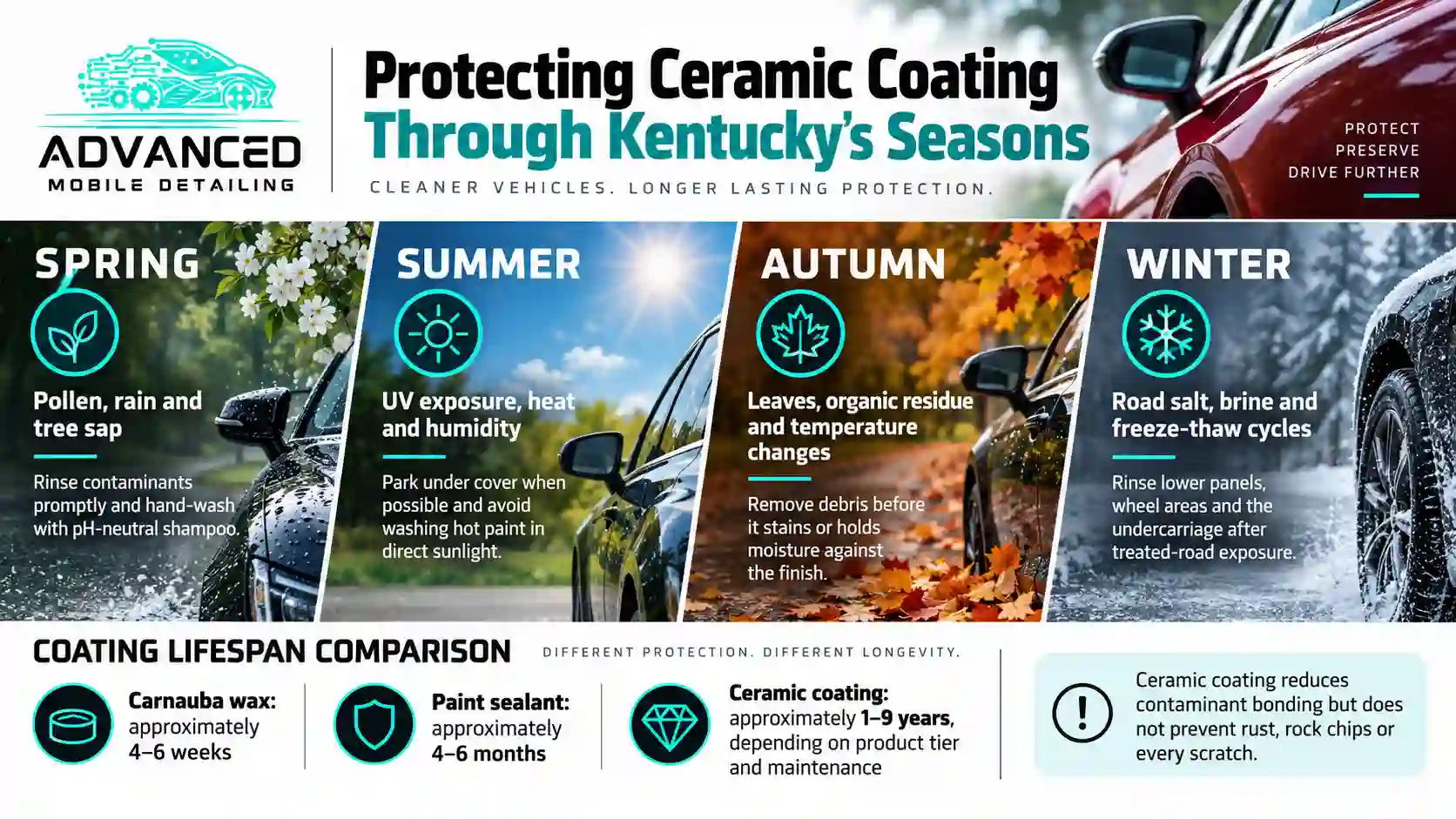
Rinsing off pollen, tree sap, and bird droppings within a few days keeps them from etching into the coating. Parking in shade or under a carport cuts the direct heat load during Louisville’s hottest stretch.
Fall and Winter Care
Rinsing the undercarriage and lower panels after road salt exposure keeps brine from sitting on the coating for days. Hand washing with a pH-neutral shampoo avoids the fine scratching that speeds up coating breakdown.
Annual inspections catch thinning spots before they turn into bare patches. A mobile car detailing service that comes to the driveway makes seasonal upkeep easier to keep on schedule.
A quick undercarriage rinse takes only a few minutes at most self-serve wash bays. That small habit does more to protect a coating than any single product.
Ceramic Coating vs Wax vs Paint Sealant in Louisville’s Climate
Carnauba wax gives a nice shine but breaks down in four to six weeks, meaning near-constant reapplication each summer. Paint sealant lasts longer, typically four to six months, though it still wears out before winter ends. Ceramic coating outlasts both by a wide margin, protecting paint for one to nine years depending on the tier.
| Protection Type | Typical Lifespan | Reapplication Frequency | Fit for Kentucky’s Climate |
| Carnauba wax | 4 to 6 weeks | Monthly | Weak against summer UV and winter salt |
| Paint sealant | 4 to 6 months | Twice a year | Moderate, wears fast through freeze-thaw cycles |
| Ceramic coating | 1 to 9 years, tier dependent | Once, plus annual maintenance | Strong match for UV, humidity, and road salt combined |
The upfront cost gap closes once you factor in reapplication over several years. Waxing monthly or resealing twice a year adds up to dozens of applications. A mid-to-high ceramic tier needs little beyond routine washing and a yearly inspection to match that same span.
Louisville’s own weather record shows why a longer-lasting barrier matters here. National Weather Service data for Louisville shows about 115 days of measurable precipitation a year. Temperatures there swing from well below freezing to over 100 degrees, a range that stresses any exposed clear coat.
Conclusion
Ceramic coating in Kentucky typically lasts 1 to 9 years, depending on the tier applied. Real-world results usually land near the lower half once summer UV, humidity, and winter salt are factored in. A higher tier, a clear warranty, and steady seasonal care close most of that gap.
Vehicle owners curious about unprotected paint can read how Kentucky sun exposure damages car paint faster than most expect. Advanced Mobile Detailing works through these factors with every client to match the right coating tier to each vehicle.
Frequently Asked Questions
How long does ceramic coating actually last on a car parked outside in Louisville?
A mid-tier coating typically lasts 2.5 to 3 years outdoors in Louisville, while premium 5- to 9-year tiers can hold up much longer with regular rinsing, pH-neutral washing, and annual inspections that offset the region’s summer UV, humidity, and winter road salt exposure each year.
Does Kentucky’s freeze-thaw winter weather shorten ceramic coating lifespan?
Yes, repeated freeze-thaw cycles stress the coating’s bond to the clear coat, especially on lower panels hit hardest by road salt spray during storms. Rinsing off salt brine promptly and choosing a higher-durability tier both help a coating hold up through a full Kentucky winter season.
Will road salt in Kentucky wear down a ceramic coating faster than in milder climates?
Road salt sitting on lower panels and wheel wells for days at a time is more corrosive than plain rainwater, and it can thin a coating’s hydrophobic layer faster on splash zones near the wheels. Rinsing the undercarriage soon after winter storms limits this damage significantly each season.
How often should ceramic coating be reapplied for a car driven year-round in Kentucky?
Entry-level 1- to 2-year coatings often need reapplication on roughly that same local timeline each year, while 5- to 9-year professional tiers usually only need a light maintenance detail and yearly inspection, not a full reapplication, to stay protected through Kentucky’s seasons.
Is a 5-year ceramic coating worth it for someone who parks outside in Louisville?
For outdoor parking in Louisville, yes, especially on a daily driver. Higher tiers resist the area’s UV load and winter road salt better than 1- to 2-year products, so the added upfront cost usually offsets the price of more frequent reapplication over that same five-year stretch.
What is the first sign that a ceramic coating is wearing off in Kentucky weather?
Water beading is usually the first sign to fade on a Kentucky-driven vehicle, often within the first year outdoors. When water starts sheeting instead of forming tight beads on the hood or roof, the hydrophobic layer has thinned, and you should schedule a maintenance detail or inspection soon after.