
Louisville drivers weighing whether ceramic coating is worth it are usually asking one real question. Does the protection justify the cost for how this car is driven and parked? Advanced Mobile Detailing offers professional ceramic coating in Louisville for daily commuters, garage-kept weekend cars, and everything in between. That work spans Louisville, St. Matthews, and Jeffersontown. The honest answer depends on driving habits, parking, and how long you own the vehicle.
What Does Ceramic Coating Actually Protect Against?
Ceramic coating is a liquid polymer, usually silicon dioxide-based, that chemically bonds to a vehicle’s clear coat. Once cured, it forms a semi-permanent layer over the factory paint. Unlike wax, it does not wash off in a few weeks.
That bonded layer creates two real advantages. It gives a hydrophobic surface that sheds water and dirt. It also adds a barrier against UV rays, oxidation, and chemical contaminants. Paint stays glossy longer, since less grime and sun exposure reach the clear coat. Kentucky’s intense summer sun is exactly the kind of stress that fades unprotected paint fast. Louisville drivers can see how in this look at how Kentucky sun exposure damages car paint.
Bird droppings, tree sap, road film, and light acid rain also struggle to bond to coated paint. Bare clear coat has no such resistance. That is a chemical benefit, not a physical one, and the difference matters for what comes next. Gloss retention is the benefit most owners notice first. A cured coating gives paint a deeper shine, and that shine holds up over time.
What Ceramic Coating Can’t Protect Your Car From
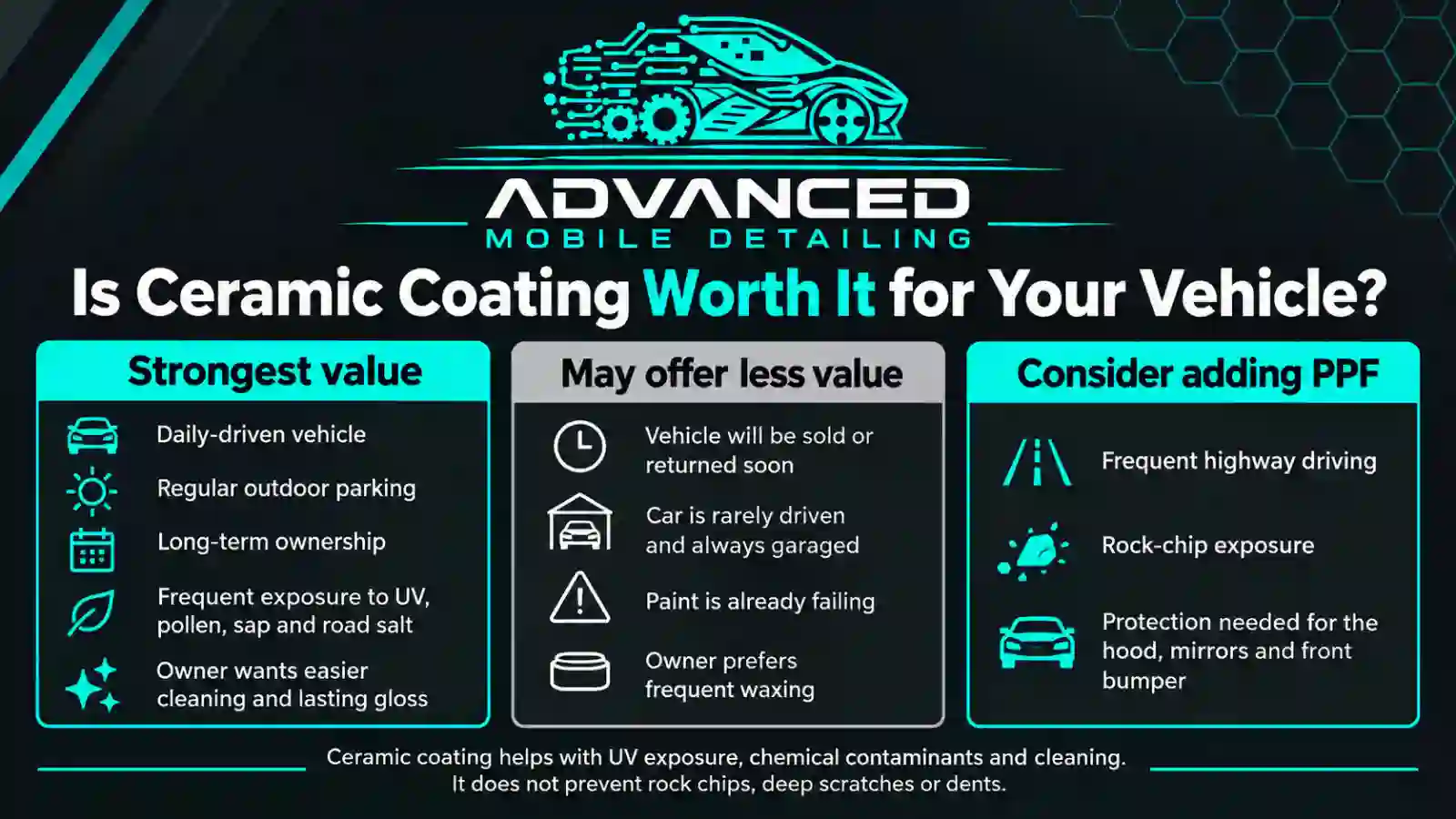
Ceramic coating is often mistaken for a suit of armor. It is not. Advanced Mobile Detailing tells every Louisville customer the same thing upfront. It can’t meaningfully stop rock chips, deep scratches, or dents. Those are physical impacts, and the coating itself is only a few microns thick.
A coated hood can still pit from highway gravel on I-64 or the Gene Snyder. Fine swirl marks from careless washing can still dull the surface over time. The coating resists them better than bare paint, but it does not prevent them outright. Vehicles that need real impact protection benefit more from detailing and paint correction. Pairing that with paint protection film covers what coating alone cannot.
Water spots are another limit worth naming honestly. A coated surface sheds water faster and beads it into smaller drops, which reduces spotting. It does not make a car immune to Kentucky’s hard water and mineral deposits. Owners expecting a maintenance-free finish are usually disappointed. Coating changes the upkeep required; it does not remove it.
Why Louisville’s Weather Makes Paint Protection Worth Considering
Local detailers see the same pattern every season on Louisville vehicles. Paint ages faster than most owners expect because of the local climate. This section is where the investment case actually gets tested.
Summer Heat and UV Exposure
Louisville summers regularly push into the 90s. Heat index readings have topped 100 degrees during peak months. That combination of intense sun and heat speeds up oxidation and fading, especially on darker paint and red tones. A cured ceramic coating adds a UV-resistant layer that slows how fast this damage shows up.
Humidity, Rain, and Water Spotting
Louisville’s humidity typically runs in the 60s to low 70s percent range for much of the year. Summer storms arrive fast and often. That moisture, combined with mineral-heavy tap and rain water, sets up water spotting on bare paint. A hydrophobic coating helps water sheet off before it dries into hard spots.
Pollen, Tree Sap, and Bird Droppings
Louisville consistently ranks among the country’s toughest cities for spring pollen. Mature tree cover across neighborhoods like the Highlands and Anchorage adds sap and debris on top of that. These acidic contaminants etch into unprotected clear coat if left to bake in the sun. A coated surface gives owners a longer window to rinse them off first.
Winter Road Salt and Freeze-Thaw Cycles
Kentucky winters bring road salt and brine treatments. Freeze-thaw swings stress both paint and metal through the season. Salt residue speeds up corrosion on exposed trim and lower panels. Owners can time reapplication so protection stays strong through winter. Knowing how long ceramic coating actually lasts through Kentucky weather makes that timing easier.
Does Outdoor Parking Change Whether Ceramic Coating Is Worth It?
Parking conditions matter more than most owners expect. A car that lives outside in a driveway or apartment lot faces constant sun, pollen, and contamination with no break. That is where coating pays for itself fastest, since it absorbs stress every day.
A garage-kept vehicle that only sees weekend miles has a much lighter exposure load. Coating still helps with gloss and easier cleaning. The urgency drops, though, since the paint is not fighting UV and grime around the clock. Even partial shade at work or overnight reduces the daily UV dose the coating has to offset.

Who Gets the Most Value From Ceramic Coating in Louisville?
Daily commuters who park outside get the clearest return. Their paint absorbs the most cumulative sun, salt, and contamination exposure. New vehicle owners benefit too. Coating protects factory paint while it is still in its best condition, rather than after damage starts.
Long-term owners planning to keep a vehicle five or more years see compounding value. Consistent protection across many Louisville summers and winters adds up. Advanced Mobile Detailing regularly walks customers through this tradeoff before recommending a coating tier. Understanding how mobile detailing works in Louisville shows why pairing coating with regular washes matters just as much.
Fleet and work vehicles that stay outside and get washed less often see a faster payoff too. The gain comes mainly through reduced cleaning time and slower fading. Rideshare and delivery drivers fall into this same category. Their vehicles rack up far more exposure hours than an average commuter.
When Ceramic Coating May Not Be Worth the Investment
Short-term ownership changes the math. A vehicle sold or leased out within a year rarely stays owned long enough to recoup the cost. That applies to both resale value and reduced maintenance.
Older vehicles with heavy oxidation, faded clear coat, or failing paint are poor candidates too. Coating locks in whatever condition the paint is already in. It cannot restore paint that has already failed. Correction work has to happen first, and sometimes the paint is too far gone for that to make sense.
Owners who enjoy hand waxing every few weekends and rarely park outside may see less benefit. Their routine already limits contamination bonding. Budget-tier vehicles nearing the end of their usable life are a similar case. The cost rarely matches how much longer the car will realistically stay on the road.
Ceramic Coating vs Wax and Sealant: What Actually Holds Up Here
Carnauba wax looks good briefly but typically breaks down within four to six weeks in Louisville heat and rain. You have to reapply it constantly through a Kentucky summer to get real protection. Paint sealants last longer, often four to six months, and sit as a middle step.
Ceramic coating outlasts both by a wide margin. Professional-grade coatings last one to nine years, depending on the tier and upkeep. Gtechniq-accredited installations chemically bond rather than sitting on top of the clear coat. That bond is why they resist washing away in Louisville rain.
For owners who do not want to reapply protection every season, that durability is the core value argument. The upfront cost is higher, but spread across several years it often works out cheaper than repeated waxing.
Does Ceramic Coating Replace Paint Protection Film, or Work With It?
Paint protection film is a thick, physical film applied to high-impact areas like the front bumper, hood, and mirrors. It is the only product here built to absorb rock chips and gravel strikes. It has real thickness, not a microscopic chemical layer.
Ceramic coating and film are not competitors. Many Louisville owners apply film to the front end for impact protection. They then coat the film and the rest of the vehicle for gloss and easier cleaning. That combination covers both the physical and chemical sides of paint protection. It matters most on vehicles that rack up highway miles around Louisville.
How Much Maintenance Does a Ceramic-Coated Car Still Need?
Coating reduces maintenance. It does not eliminate it. Regular hand washing, ideally every one to two weeks, is still needed. That removes pollen, salt, and grime before they sit on the surface too long.
Automatic tunnel washes still pose a risk, even on coated paint. Aggressive brushes can add swirl marks and strip topper products faster than hand washing. Understanding why automatic car washes in Louisville can undo that protection helps owners protect their investment. A soft two-bucket hand wash with pH-neutral soap keeps that hydrophobic layer performing.
Most professional coatings also benefit from an annual inspection. That confirms the hydrophobic layer is still performing. Still remove bug splatter, tar, and tree sap promptly. Letting acidic residue bake in the sun for days can stress even a coated surface.
Louisville’s Climate, by the Numbers
Local climate data backs up what Louisville detailers see on paint every season. National Weather Service Louisville climate data shows summer heat index readings that have exceeded 100 degrees. Dew points also run regularly in the 70s during peak humidity months.
Winter brings routine freeze-thaw cycles and road salt use across the metro. Spring and early summer bring some of the region’s heaviest pollen counts. Together, these conditions create near-constant exposure that unprotected paint must absorb.
Is Ceramic Coating Worth It in Louisville? The Bottom Line
For daily drivers, outdoor-parked vehicles, and long-term owners, ceramic coating is a reasonable investment. It stands up against Louisville’s heat, humidity, pollen, and road salt. It will not stop rock chips or dents, and it does not remove the need for regular washing. It does meaningfully slow fading, oxidation, and contamination bonding across a full Kentucky driving season.
For short-term owners, vehicles with failing paint, or garage-kept cars with light exposure, the case is weaker. That budget may be better spent elsewhere. Advanced Mobile Detailing walks Louisville owners through that decision honestly, rather than defaulting to a universal recommendation. Pairing coating with the right wash routine keeps results looking right for years. See the difference between mobile detailing and a traditional car wash.
Frequently Asked Questions
Is ceramic coating actually worth it for someone who drives their car every day in Louisville?
Yes, for most daily drivers. Constant Louisville sun, pollen, and road grime exposure means coated paint fades and stains less than bare paint. Cleaning also takes noticeably less weekly effort, and the finish holds its gloss much longer across a full Kentucky driving season each year.
Does ceramic coating help with Louisville’s pollen, rain, and road grime?
Yes, it helps meaningfully with all three. The hydrophobic surface sheds water and loose debris before it bonds to the paint. Pollen, tree sap, and light road film rinse off more easily than on bare, unprotected clear coat, especially during Louisville’s heavier spring pollen weeks.
Is ceramic coating worth it for a vehicle that’s parked outside all the time?
Often yes, since outdoor-parked cars absorb the most UV, pollen, and contamination with no break at all. That constant exposure is exactly where coating provides the clearest, fastest-felt benefit for Louisville owners. A garage-kept vehicle sees much lighter daily wear by comparison.
Is it worth coating a brand new car instead of an older one?
New paint is in its best possible condition, so coating locks in that quality early. With proper care, it keeps the paint looking that way for years longer. Older paint with existing oxidation needs correction work first, since coating cannot undo damage that already happened to the clear coat.
Does ceramic coating actually reduce how much I have to wash and maintain my car?
It reduces effort, not the washing schedule itself. Hand washing every one to two weeks is still recommended for most Louisville vehicles. Dirt, salt, and grime rinse off much faster, though, and swirl marks are far less likely with gentle, consistent washing technique over time.
When would paint protection film be a better choice than ceramic coating alone?
PPF makes more sense for high-impact areas like the hood, mirrors, and front bumper. It is the only option here that meaningfully resists rock chips kicked up from Louisville highway gravel. Many local owners combine film up front with a full ceramic coating everywhere else on the car.